Menu



If you and your spouse are ready to end your marriage without a courtroom battle, you are already looking at the two most popular out-of-court divorce options Minnesota couples use: collaborative divorce and mediation. Both keep you out of the courtroom, both tend to cost less and move faster than litigation, and both aim for a settlement that works for your family and that both of you can agree to. However, they are structured very differently, and choosing the right one can save you time, money, and stress.
In mediation, you and your spouse work with a single neutral mediator. The mediator does not represent either of you and cannot give legal advice. Their job is to help you gather the right information, identify issues, facilitate productive conversations, and help you reach agreements on property division, parenting time, child support, spousal maintenance, and every other issue your divorce needs to resolve.
Because there is only one professional guiding the process instead of a full team, mediation may be faster and less expensive, often wrapping up in just a few months. It works best when both spouses can communicate reasonably well, are willing to compromise, and do not need ongoing legal advocacy throughout negotiations.
Many people who have children prefer to avoid appearing in court, even for a default hearing. They may still each hire a consulting attorney to draft and review the legal documents before signing. Although the attorney is not typically part of the mediation sessions, they can participate when needed.
Collaborative divorce works differently. Each spouse hires their own collaborative divorce attorney who has been specifically trained in this process. Everyone, including both spouses and both attorneys, signs a participation agreement committing to resolve the divorce entirely through negotiation. Minnesota is where collaborative law began, having been developed in Minneapolis in 1990, making it a well-established option in the state.
The defining feature is the disqualification clause. If either spouse decides to take the case to court, both collaborative attorneys must withdraw, and each spouse must hire new litigation counsel. That built-in consequence gives everyone a strong incentive to stay at the negotiating table and work toward a settlement. It also encourages attorneys to focus on problem-solving while considering not only their client's interests but also the needs of the entire family.
Collaborative divorce often includes other neutral professionals, such as a financial specialist to help organize assets and debts, and a family or divorce coach to help manage the emotional aspects of the process, especially when children are involved, while also assisting with parenting plans.
Because of this larger professional team, collaborative divorce generally costs more and takes longer than mediation. However, it also provides more built-in support and continuous legal guidance. Many people feel more confident in the final agreement because they receive ongoing legal advice and benefit from neutral professionals who help evaluate financial matters and advocate for the children's interests. The result is a settlement that is carefully tailored to the family's unique needs.
A few questions can help you determine which out-of-court divorce option may be the best fit.
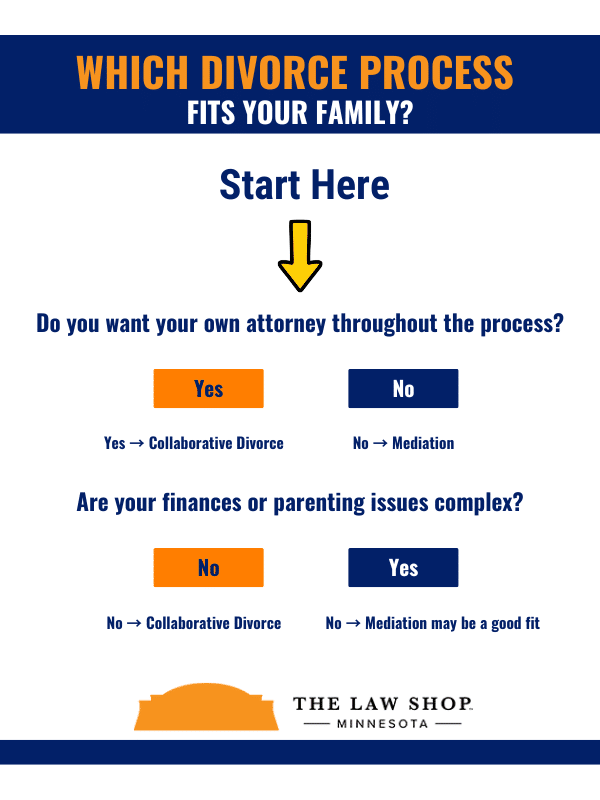 If you want your own attorney guiding and advising you throughout the process, collaborative divorce is designed for that. A mediator must remain neutral and cannot advocate for either spouse. Advocacy does not mean creating conflict. Instead, it means helping clients feel heard, identifying solutions that meet both parties' interests, and keeping children out of the middle of disputes.
Collaborative attorneys can also serve as consulting attorneys for clients participating in mediation whenever legal advice is needed.
Collaborative divorce's team approach, including attorneys, financial professionals, and family specialists, is often better suited for complicated financial situations, business ownership, or challenging co-parenting issues.
Mediation is generally quicker and less expensive because fewer professionals are involved. However, mediation can lose momentum if both parties are not moving forward at a similar pace. If keeping costs low and resolving the divorce quickly are your highest priorities, and your situation is relatively straightforward, mediation may be the better choice.
Both processes require cooperation. However, mediation depends more heavily on the spouses' ability to negotiate directly with one another. Collaborative divorce provides additional structure, guidance, and support when communication is strained or difficult issues need to be addressed.
Neither option is better in every situation. The right choice depends on your finances, your parenting responsibilities, your communication style, and the level of professional support you want throughout the process. Meeting with a collaborative divorce attorney can help you understand which option best fits your family's circumstances or whether a hybrid approach makes sense.
Choosing between collaborative divorce and mediation is one of the first major decisions you will make during your divorce, and it shapes everything that follows. Before committing to either path, it is worth discussing your situation with an experienced Minnesota family law attorney who understands both mediation and collaborative divorce. They can explain each process, answer your questions, and help you choose the approach that best protects your interests and your family's future.
The Law Shop Minnesota offers a joint spousal education session that explains both options so couples can make a mutually informed decision about how to move forward before deciding which professionals to work with.

© 2026 The Law Shop Minnesota|View Our Disclaimer|Privacy Policy
 Share
Share